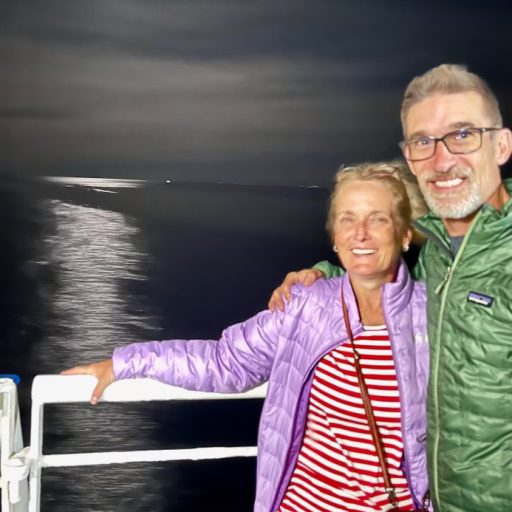
Meanwhile, dans ma tête, la vie continue et mes rêves aussi –
When we last spoke, I was preparing for our trip to Quebec, awaiting the birth of my third grandchild and attempting to unpause from an eight month self imposed work furlough (although I substitute taught with the local school – AND wow teachers really are amazing).
Emma Kate is here and surprised us all with the need for open heart surgery 48 hours post birth (details in Part 2).
Et maintenant, le québec était merveilleux. C’était très beau et je parlais français.
Unpausing has been a blessing and a challenge, mais c’est la vie.
Quebec is 17 hours from my driveway in Kentucky –
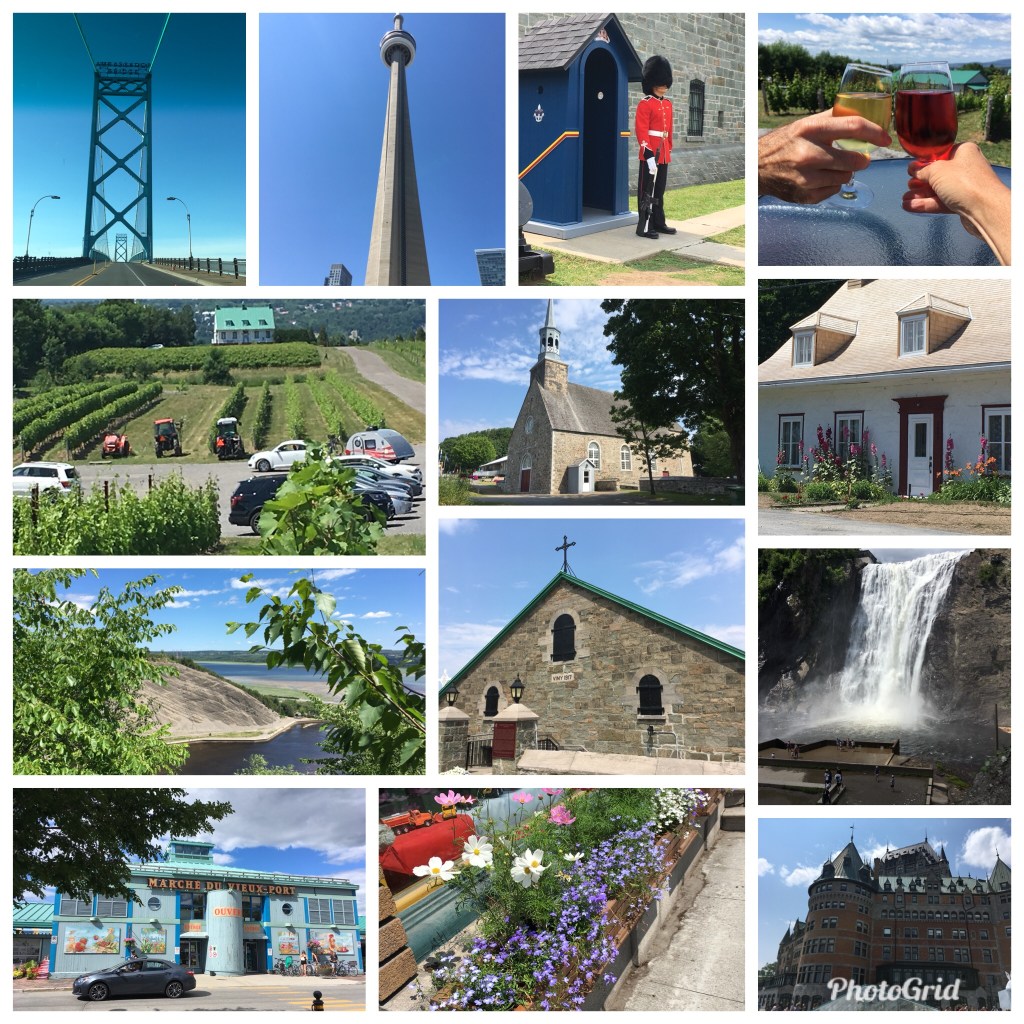
We broke up the hours with an overnight stop in Detroit to see family then a night in a tent in Toronto and a trip up the CN Tower before finally arriving at our campsite on the île d’Orléans five miles from the old city of Quebec.
A week stay on the island surrounded by vineyards, fudge shops and quiet. Morning and evening walks on the shore of the Saint Lawrence river, day dreaming of Jacques Cartier who arrived here in or about 1535 – I found myself recalling my 9th grade Michigan history class and stories of fur trappers and early settlers (Michigan was part of New France from 1668 to 1763).
Preparing to visit Quebec, I spent a lot of time reading and listening to relevant historical material. All of which is INCROYABLE and too much to detail here.
Our visit to the Citadelle of Quebec was one of the most memorable experiences of the trip. The battle that occurred here in 1759 was named the Battle of the Plains of Abraham (named after the original land owner Abraham Martin) and occurred during the Seven Years’ War and was won by the British commanded by General James Wolfe (the North American conflict is known as the French and Indian War 1754 to 1763 in the United States and was part of the Seven Years’ War).
I recommend a review of this pivotal and decisive battle where both generals lost their lives – Wolfe at the beginning of the battle and French General Montclam dying the next day from his injuries. According to the tour guide and historical fact, France eventually ceded most of its North American holdings to Great Britain in the Treaty of Paris (Treaty of 1763).
This war reshaped the world and is one of my favorite time periods to explore. Understanding it – you see how it set the stage for the American Revolution, which eventually influenced the French Revolution, which reminds me of my favorite general, General Lafayette (oh how I love to read).
Maybe I’m Canadian. Actually, my Great-Great Grandfather John Daugherty was born in 1851 in Whitchurch-Stouffville, York, Ontario, Canada. His father Benjamin Daugherty had immigrated to Canada from Ireland. John eventually married my Great- Great Grandmother Ellen Hanlon born in 1859 in Ingersoll, Ontario, they migrated to Detroit where my Great Grandfather Henry Daugherty was born in 1892. This grandfather I knew, although he died in 1970 when I was five, I still remember his green leather chair and ottoman and the silver dollar coins he would give me. Later I heard the stories of his (rambunctious) youth and motor cycle racing and I grew up playing on the sod farm he and my Grandfather established after the second world war with funds from my Grandfathers low-interest G.I. Bill loan.
Truth be told, I’m a history freak – but after a full day of bike riding we did manage to enjoy a relaxing romantic afternoon in the old city under the well known summer umbrella sculpture. Amazingly, we were in Quebec when France was battling it out for the Word Cup. During one of their wins, YOU would have thought we were in France. As we sat outside a lovely street café enjoying a glass of wine – LOUD shouts of Vive la France, rang from the pub next door. We of course ran into the crowded entry way to be a part of this momentous event. I seriously felt as if I were in France – or Detroit during Hockey season!
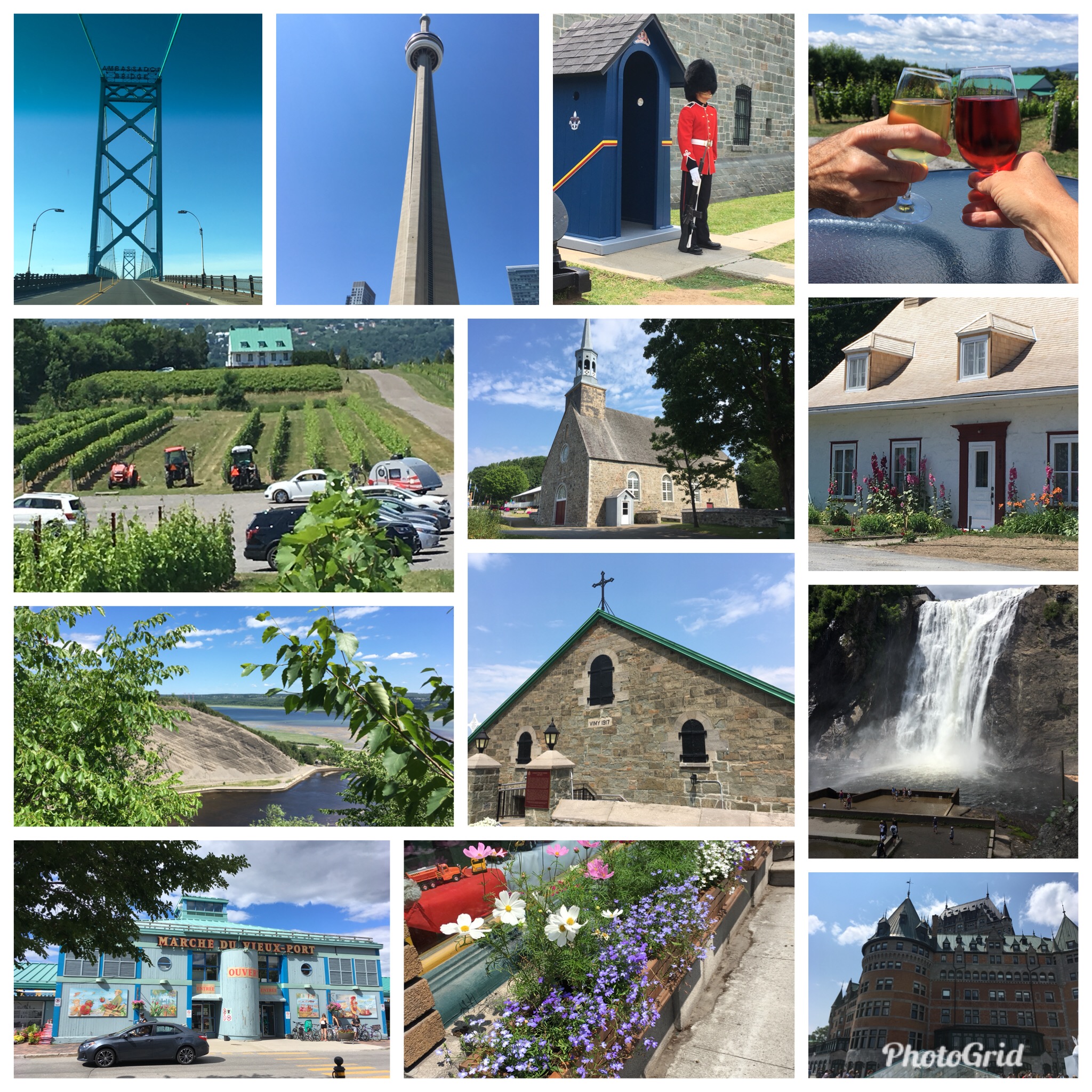
So much to explore and to share. It was absolutely gorgeous, from camping on the island (where a clean, warm shower was just a looney – slang for a dollar) to the historical old city to the beautiful natural Montmorency falls. I cannot say enough about our trip. We had a hard time not stopping at every ONroute (rest stop/gas station) we passed – how cool are they.
On one of our last nights we enjoyed a run with a local running store. I had to really pull the french out of my arse on this one as only one person in the group spoke English. The group was super kind and we got a free store sponsored running hat.
A little on the English / French language thing –
My observations:
In Ontario all the street signs were in English and French (very nice). As soon as we crossed into the province of Quebec the street signs were only in French (very nice as well), I was surprised by this but soon adjusted and it made for great practice (GOAL of the trip – speak French).
English was spoken in Ontario and French was spoken in Quebec. In Quebec if you needed someone to speak English (at least in the service sector) they could and much better than I can speak French. They have managed to master bilingualism – I don’t know what the future holds but for now – they’ve got a grip on it and I hope they maintain it.
My attempt to speak French was welcomed and appreciated. Although the accent is different from the region of France we normally visit, we quickly adjusted. Several months of listening to French Canadian radio helped. Some of the words were different such as the French (most likely old French) word dépanneur, which the dictionary translates to troubleshooter, and is actually used to describe the local grocer. I don’t recall ever seeing this word in France.
On our first night on the island, we drove and drove looking for le magasin, le marche, or even possibly le supermarché. Hungry and tired, we found nothing. Finally stopping for directions, a kind man gave us directions to le dépanneur. Quoi! I googled the word and troubleshooter came up. So here’s my take on this one – le dépanneur was most likely the trouble shooter of the area 300 years ago. They most likely supplied necessities and assistance to the fur trappers and early settlers similar to a general store. They were probably known as the local SME (subject matter expert). Again – I drift off to another time and place. Warning: this is just my take and most likely not historically correct. Humor me people.
My take on Quebec –
A big ole chunk of Europe (particularly France) was dropped into North America.
Language, food, markets, bakeries, cafes – this town has it all. It reminded me of how I felt when we visited Victoria, British Columbia in the 1990’s – very European and very clean.
Best memory –
Driving north across the Ambassador bridge (in Detroit) and feeling as if I was transported back to 1975.
Thank you Canada, particularly Ontario and Quebec for a great visit – we will be back.


 Suz Learns @ Behind the Postcard